


A visit from a health and safety enforcement inspector is rarely a routine interruption. Inspectors often arrive unannounced, observing your operations long before they step through the door. In those first moments, how your people respond to a Health and Safety Enforcement Officer can expose more about your leadership and culture than months of internal reporting. The question for directors and senior managers is simple: Would your organisation withstand that level of scrutiny today?
Confidence that your arrangements are robust, understood, and consistently applied is a critical line of defence against regulatory action, reputational damage, and personal liability exposure. Where that assurance is weak, enforcement outcomes tend to be decisive and unforgiving. This blog includes a free download to a Board-ready checklist which includes a RACI to determine how unplanned enforcement visits are managed and who is accountable.
Forward‑thinking Boards recognise that assurance does not come from paperwork alone. It comes from having clear, informed oversight of how enforcement works in practice, what inspectors look for, and how regulatory decisions are made. Without that insight, organisations are left reacting rather than staying one step ahead.
Staying ahead of enforcement requires more than delegating health and safety down the organisation. It demands informed oversight of how enforcement actually works: what triggers regulatory attention, how inspectors exercise discretion, and how quickly a routine visit can escalate into formal action. Without that insight, leaders are left reacting to events rather than shaping outcomes.
With that in mind, below are some must‑know facts about health and safety enforcement that every senior leader should be aware of.
Who Enforces Health & Safety Law?
Health and safety law enforcement is implemented by government inspectors, ie HSE Inspectors, Local Authority Health & Safety Inspectors and Environmental Health Officers. They may be cross‑warranted, meaning they can act outside their usual sector. Regardless of who attends, their legal powers are the same. Inspectors enforcing fire safety standards have the same powers. If they issue an enforcement notice (Improvement Notice, Prohibition Notice or they prosecute), they publish the details on their website.
What Powers do Inspectors Hold?
Health and safety inspectors have extensive powers, arguably broader in some respects than those held by the police. Under Section 20 of the Health and Safety at Work etc. Act 1974, inspectors can:
- Enter premises at any reasonable time without a warrant
- Examine and copy general documents (risk assessments, policies, training records, procedures). Documents containing personal data of individuals are included provided the personal data is redacted.
- Take samples and seize items (including CCTV) of equipment for testing etc
- Interview employees and take formal statements
- Investigate incidents, complaints, and concerns
They may bring police officers if they anticipate obstruction or safety risks. Obstruction is a criminal offence. Further details can be found here.
How Health & Safety Enforcement Works
If breaches are identified inspectors may take one or more of the following actions:
1. Fee for Intervention (FFI)
- This is the lowest level of Health and Safety Enforcement. A Fee for Intervention is issued where a material breach is found (usually not life threatening but still breaching a legal requirement). It is the least serious enforcement outcome and is not published publicly which is good news for organisations where reputation and tender competitiveness are critical.
- Charged at £183 per hour (rate reviewed annually in April)
- Withdrawn once the breach is remedied
- Does not need to be disclosed to insurers or in tender submissions
While often viewed as minor, an FFI is still a clear signal that controls were not effective at the point of inspection.
2. Improvement Notice
Issued when a breach requires formal correction. This is the lesser of the more formal type of notice, and does exactly what it says, ie: requires you to improve. The notice will:
- State what law has been broken, the reason why
- Include a compliance period (minimum 21 days and often longer depending on time needed to implement the improvements)
- Operations may continue during compliance or if you decide to appeal
- Becomes public record after 21 days
For Boards, Improvement Notices are visible indicators of governance and oversight performance, with potential implications for reputation, tenders, and stakeholder confidence.
3. Prohibition Notice
A Prohibition Notice is the most serious enforcement action.
- Issued where there is a risk of serious personal injury
- Stops the specified activity immediately (unless deferred) which can have significant operational implications
- Remains in force even if appealed against
- Becomes public record after 21 days
From a commercial and governance standpoint a Prohibition Notice can be severely damaging, particularly for organisations operating within regulated supply chains or competing in tender‑driven markets. Because it signals an immediate and serious risk of injury, the next step is often prosecution, creating significant exposure to both corporate sanctions and potential personal liability for senior leaders.
For Boards, both Improvement and Prohibition Notices are visible markers of governance performance that requires closer scrutiny.
When do Enforcement Inspectors Visit?
Common triggers include:
- Complaints from employees, contractors, or the public (they can make an anonymous complaint and the inspector is duty-bound to follow up on it).
- Targeted campaigns focusing on high‑risk activities (e.g., work at height, workplace transport) or industry sectors. A recent campaign was announced by the HSE that it was going to target large bakeries, for example.
- Following a reportable incident under RIDDOR (Reporting of Injuries, Diseases & Dangerous Occurrences Regulations 2013).
- An inspector happens to be passing and notices unsafe behaviours or activities in operation.
HSE have produced free guidance on this topic to help you, which can be accessed from here.
What Do Enforcement Inspectors Look For?
Their focus depends on the trigger for the visit, but typically includes:
- Housekeeping and workplace organisation
- Segregation of vehicles and pedestrians
- Machine guarding and equipment safety
- Use and compliance with PPE standards
- Safe behaviours and supervision
- Welfare facilities, cleanliness and hygiene
- Management of high‑risk activities, eg use of ladders or access equipment
- Access to competent health and safety advice
This list is not exhaustive. Inspectors may arrive to investigate a single issue but often identify multiple concerns during the visit. Because impressions are formed within minutes, a prompt, well‑managed, and professional response is critical to maintaining control of the situation and ensuring effective crisis management.
How to Respond: Leadership Essentials
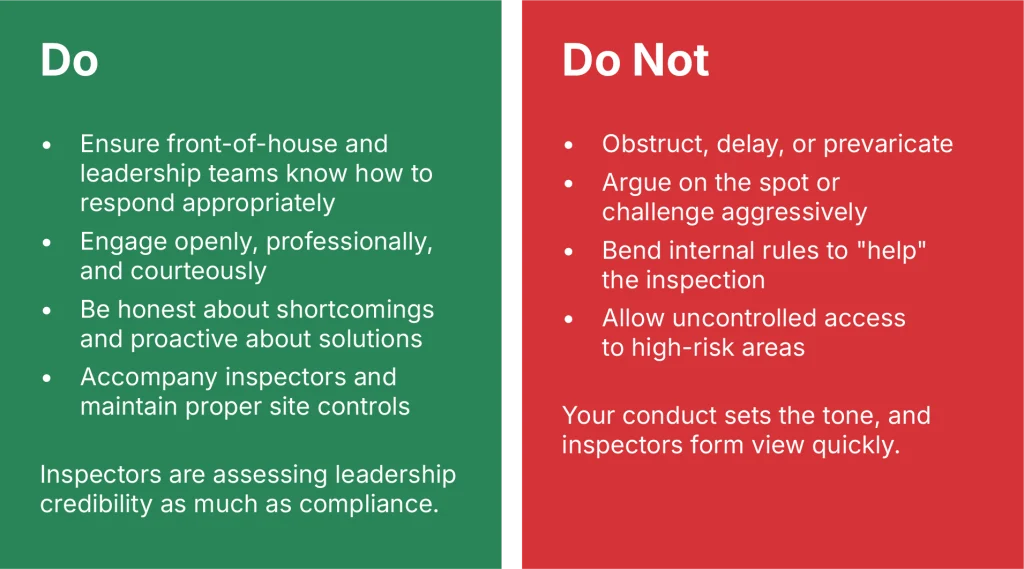
3 Key Tips for managing an enforcement visit:
- Ensure your front of house are properly briefed, trained and prepared to welcome an inspector and alert your senior team. They are the ones who make the first impression.
- Lead by example by investing just 5–10 minutes to observe yourself your working conditions, practices (include checking noticeboards contain up-to-date information) — inspectors check these too. This is a quick, cheap and highly effective way to gain assurance or address areas of concern.
- Ensure your managers are briefed and know how to respond. Test your system to obtain the assurance you need.
Final Thought
Forward‑thinking organisations often take a moment to quietly test how prepared they are for an unplanned enforcement visit, much like running an unannounced fire drill to confirm systems work as expected. It’s a simple way to gain genuine confidence in your readiness, and if strengthening that assurance is something you’re exploring, we’re always here to support you.
To support that reflection, we’ve included a practical one‑page Board Review Checklist with the key questions senior leaders should be asking. And if strengthening this level of assurance is something you’re exploring, we’re here whenever you need us.
You can download this now. Simply complete the details below to get the PDF.


